
Autism vs. ADHD vs. Developmental Delay: A Parent's Guide to Understanding Your Child's Needs in Mississauga
If you’re a Mississauga parent who has heard three different opinions from three different professionals, you are not alone. One doctor mentions Autism vs ADHD vs developmental delay as possibilities. Another says “wait and see.” Another refers you to a specialist with a six-month wait time. Meanwhile, your child needs support right now.
This guide is here to cut through that confusion. We’ll explain what each condition looks like, how they overlap, and what the differences actually mean for your child’s care so you can move from uncertainty to clarity, and from clarity to action.
At NeuroSpark Adaptive Learning Centre in Mississauga, we work with families navigating exactly this uncertainty every day. You don’t need a perfect diagnosis to take the first step.
The Confusion of Overlapping Symptoms: Why Diagnosis Is Hard
Why ADHD and Autism Often Look the Same
Many of the behaviours associated with autism and ADHD look remarkably similar on the surface. A child who struggles to sit still, has difficulty following instructions, or melts down during transitions could be showing signs of either condition or both simultaneously.
In Canada, approximately 36.5% of children with autism also meet the criteria for ADHD. That means for more than a third of autistic children, a single diagnosis tells only part of the story. Overlapping symptoms create genuine diagnostic complexity and parents are often caught in the middle.
The "Wait and See" Trap: Why Early Intervention Matters in Ontario
One of the most frustrating experiences for Ontario parents is being told to “wait and see” when they know something is wrong. Every month of waiting is a month without support and a month of missed developmental opportunity.
Research consistently shows that early intervention, particularly before age 5, produces significantly better long-term outcomes. The developing brain is most responsive to targeted support during these early years. Waiting is not a neutral choice. It has real consequences.
When One Diagnosis Isn't Enough: Understanding Comorbidities
Comorbidities the co-occurrence of two or more conditions are the rule rather than the exception in neurodevelopmental diagnoses. Research shows that 70% of autistic children in Canada have at least one additional diagnosis, which may include ADHD, anxiety, sensory processing disorder, or a speech and language delay.
Understanding comorbidities matters because treatment must address the full picture. A child whose ADHD goes unrecognized because autism is the primary focus may not receive the complete support they need.
Autism Spectrum Disorder (ASD): More Than Just Social Challenges
Social Communication and the 'Hidden' Signs of ASD
Most people associate autism with social difficulties but the signs of ASD go far beyond not making friends. Social communication differences in autism include challenges with back-and-forth conversation, difficulty understanding nonverbal cues like facial expressions and body language, and trouble developing and maintaining age-appropriate relationships.
What makes ASD particularly complex is that many of these signs are hidden especially in girls, who often mask their difficulties by mimicking social behaviour. A child can appear socially capable in structured settings while struggling enormously behind the scenes.
Sensory Processing: How Mississauga's Busy Environments Affect Your Child
Mississauga is a vibrant, busy city from the crowds at Square One to the noise of Celebration Square events. For children with autism, these environments can be genuinely overwhelming. Sensory processing differences mean that sounds, lights, textures, and smells that others barely notice can feel intensely distressing.
Watch for:
- Covering ears in response to everyday sounds
- Distress in crowded or brightly lit spaces
- Strong aversion to certain clothing textures or food textures
- Seeking sensation: crashing, spinning, touching
Repetitive Behaviours and the Need for Routine
Restricted and repetitive behaviours are a core feature of autism that distinguish it from ADHD and developmental delay. These include repetitive movements such as hand-flapping or rocking, insistence on sameness and routines, intense focus on specific topics or objects, and significant distress when routines are disrupted.
These behaviours serve a real function: they help children with autism regulate their nervous system and manage an unpredictable world. Understanding their purpose is the first step toward supporting them effectively.
ADHD in Children: It's Not Just About Being 'Hyper'
The Three Types of ADHD: Inattentive, Hyperactive, and Combined
ADHD is not a single presentation. It comes in three distinct types, each with its own profile:
- Inattentive type: Distracted, forgetful, disorganized often undiagnosed, particularly in girls.
- Hyperactive-impulsive type: Excessive movement, difficulty staying seated, interrupting, acting before thinking.
- Combined type: Features of both inattentive and hyperactive-impulsive presentations.
In Canada, ADHD affects approximately 5 to 9% of school-age children. It is one of the most common neurodevelopmental conditions and one of the most frequently misunderstood.
Executive Functioning: Why Your Child Struggles With Multi-Step Tasks
Executive functioning refers to the set of mental skills that help people plan, focus, remember instructions, and manage multiple tasks simultaneously. ADHD directly impairs executive functioning which is why children with ADHD often struggle with tasks that seem simple to others.
Getting dressed in the morning, completing a homework assignment, or following a three-step instruction can feel genuinely overwhelming. This is not defiance or laziness. It is a neurological difference in how the brain organizes and executes tasks.
Emotional Regulation: Managing Meltdowns vs. ADHD Outbursts
Both autism and ADHD can involve intense emotional responses but they look and feel different. ADHD outbursts are typically impulsive, reactive, and short-lived. A child with ADHD may explode in frustration and recover relatively quickly once the trigger is removed.
Autistic meltdowns, by contrast, are often the result of accumulated sensory or emotional overload. They can feel more intense, last longer, and require a more structured recovery period. Understanding the difference helps parents and professionals respond more effectively.
Understanding Developmental Delay: Is It Temporary or Permanent?
Global Developmental Delay (GDD) vs. Specific Speech Delays
A developmental delay means a child is reaching milestones significantly later than expected in one or more areas. It is important to distinguish between two types:
- Global Developmental Delay (GDD): Delays across multiple areas motor skills, language, cognition, and social development. GDD often warrants further investigation for an underlying cause.
- Specific delay: A delay in one area only most commonly speech and language while other areas develop typically.
A speech delay alone does not indicate autism. But when a speech delay occurs alongside social communication differences and repetitive behaviours, autism becomes a more likely explanation.
The Link Between Physical Milestones and Cognitive Growth
Motor development and cognitive development are more closely linked than many parents realize. Delays in sitting, walking, or fine motor skills can signal underlying neurological differences that also affect language, attention, and social learning.
In Ontario, developmental paediatricians assess children across all domains to build a complete picture of development. If your child has a motor delay alongside a speech delay, a comprehensive assessment not just a speech referral is the appropriate next step.
When a Delay Becomes a Diagnosis: The Path Forward in Mississauga
Not all developmental delays lead to a formal diagnosis. Some children catch up with targeted early intervention speech therapy, occupational therapy, or ABA support and go on to develop typically. Others receive a diagnosis of autism, ADHD, intellectual disability, or another neurodevelopmental condition as the assessment process progresses.
The key is not to wait for certainty before seeking support. NeuroSpark Adaptive Learning Centre provides early intervention services for children with developmental concerns with or without a formal diagnosis.
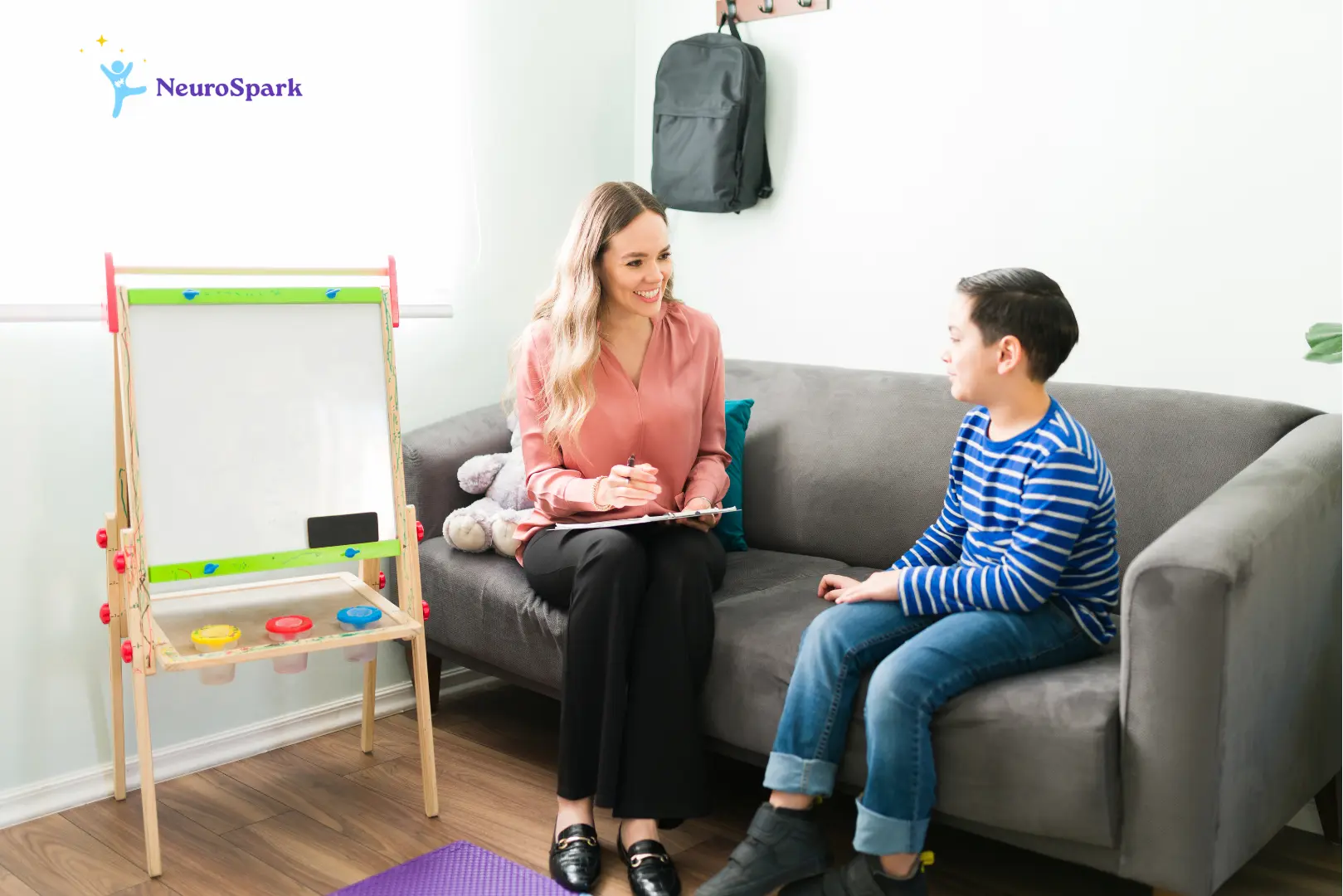
The Comparison: Key Differences at a Glance
Eye Contact and Social Reciprocity: ASD vs. ADHD
Feature | Autism (ASD) | ADHD | Developmental Delay |
Eye contact | Often limited or inconsistent | Generally typical | Varies |
Social interest | May prefer solitude; social rules feel confusing | Usually interested in peers; impulsive in interactions | Varies by area of delay |
Emotional reciprocity | May struggle to read others’ emotions | Generally intact but impulsive | Varies |
Response to name | May not respond consistently | Usually responds; may be distracted | Varies |
Routine preference | Strong preference; distress with change | Prefers novelty; resists routine | Varies |
Repetitive behaviours | Core feature | Not a core feature | Not typical |
Sensory sensitivities | Very common | Less common | Less common |
Language development | Often delayed or atypical | Usually typical | Often delayed |
Focus pattern | Intense on preferred topics | Scattered; difficulty sustaining | Varies |
OAP funding eligible | Yes | No (ABA not typically funded) | Depends on diagnosis |
Language Acquisition and Play Skills: Where Delays Differ
Children with autism often show atypical language development including echolalia, scripted speech, and difficulty with the back-and-forth of conversation. Children with ADHD typically develop language on schedule but may struggle with listening, following conversational rules, or staying on topic.
Developmental delay can affect language in various ways depending on its cause and severity. A child with a pure speech delay may have strong nonverbal communication and social engagement which distinguishes them from a child with autism whose social communication is also affected.
Focus and Interests: Hyper-Fixation vs. Distractibility
One of the clearest distinguishing features between autism and ADHD is the pattern of attention. Children with ADHD struggle to sustain attention on tasks that are not immediately rewarding; they are easily distracted and have difficulty staying on task.
Children with autism, by contrast, often demonstrate hyper-focus on topics or activities that captivate them sometimes to the exclusion of everything else. This intense, narrow focus is a core feature of autism and is qualitatively different from the attention difficulties seen in ADHD.
Why a Local Mississauga Provider Makes a Difference
Navigating the Ontario Healthcare System With Local Experts
Ontario’s healthcare and autism funding systems are complex. Understanding how to access the Ontario Autism Program (OAP), navigate school board special education supports, and coordinate between multiple providers requires local knowledge that a generic online resource simply cannot provide.
A Mississauga-based provider understands the local wait times, referral pathways, school board structures, and community resources that directly affect your family. That local expertise is a genuine advantage not just a convenience.
The Benefit of In-Person ABA Therapy Near Square One
In-person therapy allows clinicians to observe your child across real-life settings, build genuine relationships with your child and family, and coordinate directly with local schools and other providers. For children with sensory sensitivities or social communication differences, the consistency and familiarity of an in-person setting matters enormously.
NeuroSpark Adaptive Learning Centre is located at 57 Queen Street S, Mississauga easily accessible for families across the city, from Port Credit to Streetsville and beyond.
Building a Community: Connecting With Other Mississauga Parents
One of the most underrated benefits of working with a local provider is access to community. Parents who connect with others navigating similar experiences through parent training groups, support networks, and shared resources consistently report better outcomes for both themselves and their children.
NeuroSpark fosters this community intentionally. Parent training is built into every programme, and families are connected with local resources and peer support from the very beginning.
How ABA Therapy at NeuroSpark Supports All Three Needs
Individualized Learning Plans for Diverse Neurotypes
Whether your child has autism, ADHD, a developmental delay, or a combination of all three, ABA therapy at NeuroSpark begins with a thorough individualized assessment. No two programmes look the same because no two children are the same.
Goals are written in clear, measurable terms across all relevant developmental areas: communication, social skills, behaviour regulation, daily living, and academic readiness. Progress is tracked in every session and reviewed regularly with families.
Positive Reinforcement: Building Confidence and Life Skills
ABA therapy at NeuroSpark is built on positive reinforcement not punishment or compliance-based approaches. Every programme is designed to be engaging, motivating, and child-led. Children learn because they want to, not because they are forced to.
This approach is particularly effective for children with ADHD, who respond strongly to immediate, meaningful rewards. It is equally effective for children with autism, who benefit from clear, consistent feedback and structured learning environments.
Family-Centred Care: Training Parents for Success at Home
Therapy does not end when the session does. At NeuroSpark, parent training is a core component of every programme because the strategies children learn in therapy must be reinforced at home, at school, and in the community to produce lasting results.
Families receive practical, evidence-based strategies they can implement immediately. Progress reports are shared regularly. And our team is always available to answer questions and adjust the plan as your child grows.
Real Success Stories From Mississauga Families
From Non-Verbal to Communicative: A Success Story
A Mississauga family came to NeuroSpark with a 3-year-old who had fewer than five words. Within six months of intensive ABA therapy combined with speech-language support, their child was using two-word combinations consistently and initiating communication with family members. By 18 months, they were speaking in short sentences and participating in pre-school activities.
“We didn’t know what to expect. We just knew our son needed help. NeuroSpark gave us hope and then they gave us results.” Parent of a 3-year-old, Mississauga
Managing ADHD in the Classroom: Strategies That Work
A 7-year-old in Mississauga was struggling significantly in school unable to sit through lessons, frequently dysregulated, and falling behind academically. After a comprehensive assessment identified ADHD with significant executive functioning challenges, NeuroSpark developed a behaviour support plan in collaboration with the school team.
Within three months, classroom behaviour had improved measurably. The child was completing tasks with less prompting, managing transitions more successfully, and experiencing fewer daily conflicts with peers and teachers.
Overcoming Developmental Hurdles With Consistent Support
A family in the Port Credit area came to NeuroSpark concerned about their 2-year-old’s global developmental delay. No formal diagnosis had been given but the child was significantly behind in motor, language, and social development. Early intervention began immediately, without waiting for diagnostic clarity.
Over 12 months of consistent ABA and occupational therapy, the child made gains across all developmental domains. A subsequent assessment found that many early concerns had resolved significantly and the family felt equipped and confident for the road ahead.
Take the Next Step With NeuroSpark Adaptive Learning Centre
If you have been sitting with uncertainty wondering whether it is autism, ADHD, a developmental delay, or something else entirely, the most important thing you can do right now is take one step forward.
You do not need a perfect diagnosis to begin. You do not need all the answers. You just need to make the call.
NeuroSpark Adaptive Learning Centre is Mississauga’s trusted OAP-listed provider of ABA therapy, IBI therapy , speech therapy, occupational therapy, and psychotherapy all coordinated under one roof, all delivered by a credentialled, compassionate team.
You know your child. You are their best advocate. Let us help.
Call us: (905) 286-9444 Visit us: 57 Queen Street S, Mississauga Book a Free Consultation with NeuroSpark
Frequently Asked Questions
Yes. Research shows that 36.5% of children with autism also meet the criteria for ADHD. Co-occurring diagnoses are common and require a treatment approach that addresses both conditions. NeuroSpark's individualized programmes are designed to support children with multiple diagnoses simultaneously.
A formal assessment by a developmental paediatrician or multidisciplinary team is the only way to clarify diagnosis. In the meantime, document your observations carefully with specific behaviours, contexts, and patterns. NeuroSpark offers early consultation and can begin supportive intervention while you await a formal assessment.
No. NeuroSpark Adaptive Learning Centre provides early intervention and ABA consultation for children with developmental concerns with or without a confirmed diagnosis. Early action capitalizes on brain plasticity and produces better outcomes. Call (905) 286-9444 to schedule a free consultation.
Yes. While ABA therapy was developed primarily for autism, its principles of positive reinforcement, skill-building, and behaviour support are highly effective for children with ADHD, developmental delays, and other neurodevelopmental conditions. NeuroSpark tailors every programme to the individual child's profile.
Wait times vary significantly. Publicly funded developmental assessments can take several months to over a year. Private pathways are faster but involve cost. Contact NeuroSpark at (905) 286-9444 we can begin supporting your child immediately while you navigate the diagnostic process.